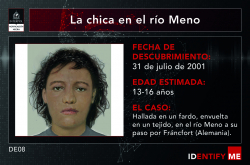





LYON, France – German authorities have arrested a suspect in a long-running cold case following the identification of a murder victim whose body was discovered in the River Main nearly 25 years ago. The teenage girl has been identified as ‘Diana S.’
The arrest was carried out on 12 May 2026 by the Hessian State Criminal Police Office, acting on the initiative of the Public Prosecutor’s Office in Frankfurt am Main. The suspect, a 67-year-old German citizen, and the victim’s father, has been placed in pre-trial detention on suspicion of murder.
The case was part of Identify Me, an international campaign coordinated by INTERPOL with six European countries (Belgium, France, Germany, Italy, the Netherlands, Spain), aiming to identify 47 women whose bodies were found across Europe over recent decades and to advance investigations.
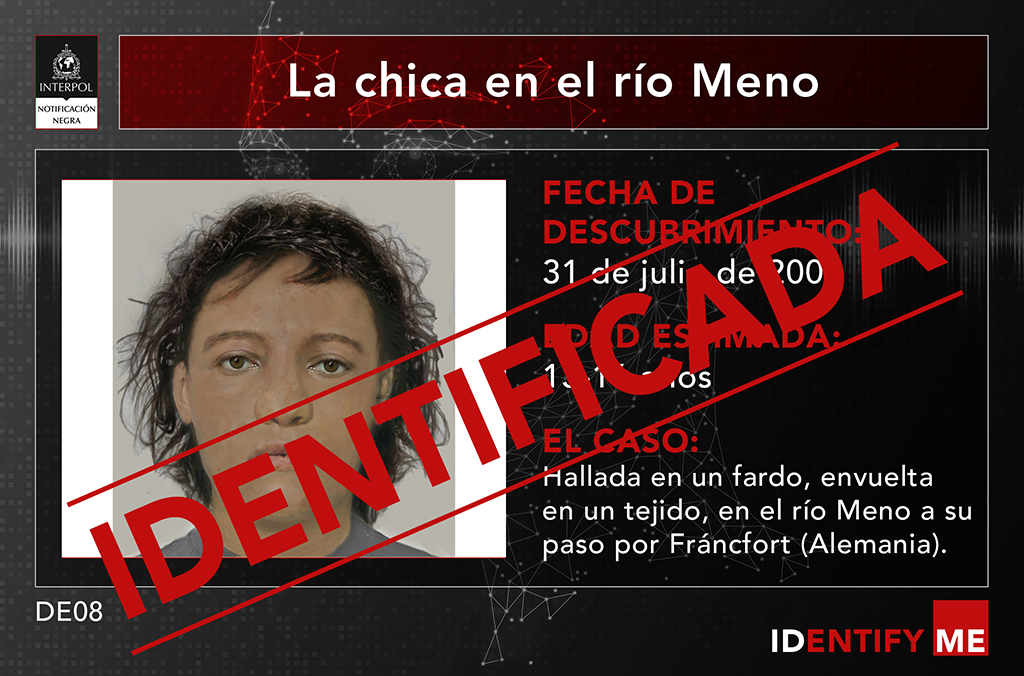
One of those cases, known as The Girl in the River Main, dates back to 31 July 2001, when the body of a young girl was discovered floating in the River Main in Frankfurt by passers-by. Investigators later determined that the victim had been violently assaulted and was aged 16 at the time of her death.
For many years, the case remained unresolved. However, a significant breakthrough came when the case was added to the Identify Me public appeal in October 2024, which called on the public to provide information relating to the victim’s identity and circumstances of her death.
Several tips from members of the public led investigators to pursue new leads, ultimately resulting in the arrest of the suspect. Investigations remain ongoing, and further details cannot be disclosed at this stage.
INTERPOL Secretary General Valdecy Urquiza said:
“This identification, followed by the arrest of a suspect, underscores how important it is to continue investigating unresolved cold cases. As part of the Identify Me campaign, the efforts of the German authorities, supported by information from the public, have helped advance a case that had remained open for a quarter of a century.
“Developments such as this highlight the benefits of combining public engagement with sustained investigative work and forensic capabilities. INTERPOL will continue to support its member countries in identifying unknown deceased persons and enhancing international cooperation in ongoing investigations.”
Identify Me
This case marks the sixth successful identification linked to Identify Me – a public appeal for information on the cold cases, which also provides an opportunity for case files to be reviewed and updated by investigators, with renewed calls for international cooperation and sharing of forensic information.
Details of each case are also published online and shared with the media, including facial reconstruction images and descriptions of personal objects or tattoos, in the hope that a member of the public might recognize something.
INTERPOL Black and Yellow Notices
Identify Me marks the first time INTERPOL has publicly shared extracts from Black Notices. These Notices are used to disseminate information globally on unidentified human remains, with the aim of determining the circumstances surrounding a death and identifying the individual.
The shared information may include details such as the location of discovery, biometric data (DNA, fingerprints, facial images), dental records, physical descriptions of the body or clothing, and any other relevant details that can help identify the deceased.
INTERPOL’s Yellow Notices are another critical tool in the effort to locate missing persons. A Yellow Notice is a global police alert for cases of parental abduction, criminal kidnapping, or unexplained disappearances, and can significantly increase the chances of locating a missing individual.
I-Familia database
Since 2021, INTERPOL has provided investigators with the I-Familia database, a global tool that currently contains more than 32,000 DNA profiles from 82 countries.
The system has already contributed to solving cases by enabling the identification of unknown bodies through international family DNA matching. This process relies on voluntary DNA contributions from relatives of missing persons, which are used solely for identification purposes and are not compared against criminal databases.
Such cases underline the crucial role played by the public and international partners in supporting ongoing investigations.
The public appeal continues: 41 remaining cases
The Identify Me campaign continues, with 41 unresolved cases still seeking answers.
Members of the public are encouraged to visit INTERPOL.int/IM and share any information that may help identify victims or advance investigations.
If you believe one of the unidentified individuals could be a missing loved one, you are urged to contact your national police authorities, who can work with INTERPOL to facilitate international DNA comparisons and help provide long-awaited answers to families.