




The Situation
Pharmaceutical crime is a major global public health concern, with the trade of counterfeit and illicit medical products a truly global criminal phenomenon affecting all countries through source, transit or destination points.
Patients across the world put their health and even their lives at risk by unknowingly consuming fake and unregulated medical products, or products that have been altered, diverted, badly stored or have passed their expiry date.
Growing consumer demand, the COVID-19 pandemic, and widespread use of the Internet has meant that the advertisement, sale and supply of illicit medical products from unauthorized and unregulated websites has become a growing problem in recent years.
The Illicit Goods and Global Health Programme (IGGH)
This programme is part of INTERPOL’s Illicit Markets Sub-directorate and is formed of two units: IP Crime and Digital Piracy, and Public Health and Pharmaceutical Crime.
INTERPOL’s IGGH programme shares a strong commitment with member countries and industry alike to continue to improve global cooperation and enforcement capabilities in the area of pharmaceutical crime.
We work to dismantle criminal networks and reduce the risk these crimes pose to public health by:
- Collecting data and disseminating intelligence (e.g. analytical reports and threat assessments);
- Coordinating transnational law enforcement operations;
- Supporting multi-agency task forces to improve cooperation between police, customs, regulatory bodies and the private sector;
- Raising public awareness of pharmaceutical crime and helping consumers to make informed choices.
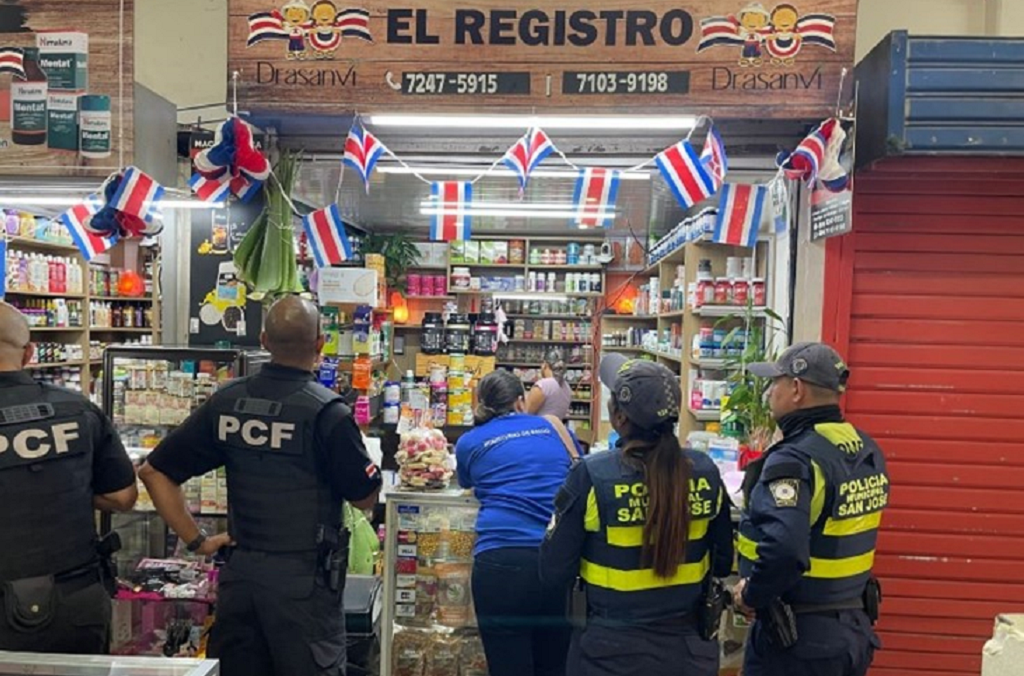
INTERPOL endeavours to create modern approaches to tackle pharmaceutical crime in partnership with law enforcement agencies, international organizations, industry and INTERPOL member countries.
Several global and regional initiatives coordinated by INTERPOL are in place to respond to specific trends and issues:
Operation Pangea (Global)
- Since 2008, INTERPOL has coordinated Operation Pangea to combat the global trafficking of counterfeit pharmaceuticals marketed and sold online. Pangea also aims to raise public awareness of the risks associated with buying medicines from unregulated websites.
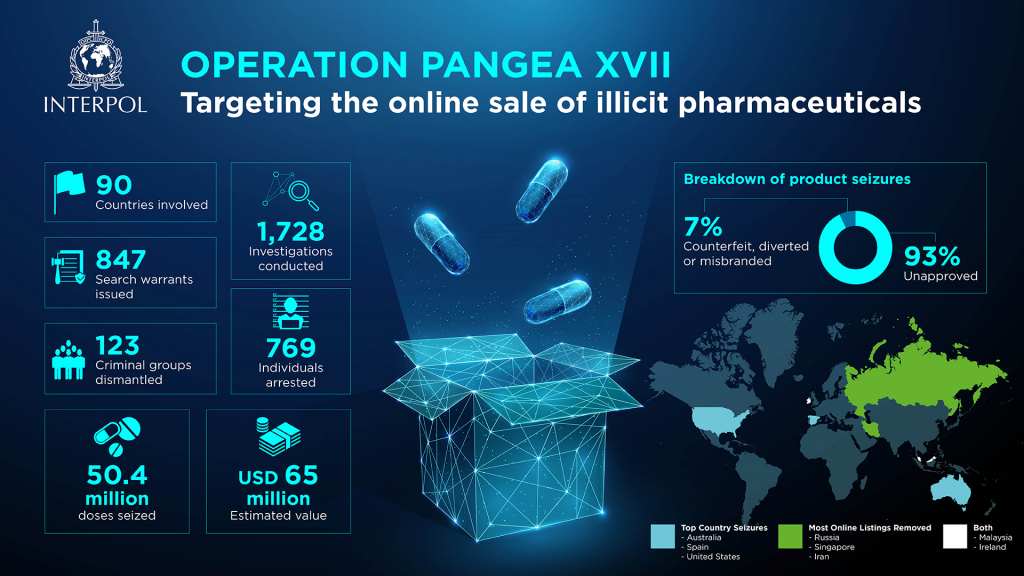
- Operation Pangea XVII took place from December 2024 to May 2025 across 90 countries. It resulted in the seizure of 50 million doses of illicit pharmaceuticals worth USD 65 million, highlighting the alarming scale of the global trade in unapproved and counterfeit medicines.
- The operation saw the arrest of 769 suspects and the dismantling of 123 criminal groups worldwide.
- In total, law enforcement agencies worldwide launched 1,728 investigations and the shutdown of approximately 13,000 criminal-linked websites, social media pages, channels, and bots used to market and sell illegal or falsified medicines.
Action against tramadol trafficking (Regional)
Established in 2020 within the framework of Operation Pangea, this initiative involves the countries most affected by tramadol trafficking across Africa. The aim is to drive investigations between both source and destination countries.
Operations Afya and Heera (Regional)
Afya is an INTERPOL-led operation targeting criminal groups involved in the manufacture and distribution of illicit goods and pharmaceuticals in the Southern Africa region. Operation Heera targets the trafficking of illegal medicines across Western Africa. Both operations also aim to raise awareness amongst the public about the dangers of using illicit goods.
Operation Qanoon (Regional)
The Qanoon Initiative was launched in 2015 following an analysis report, which revealed the threat of pharmaceutical crime to the health and wellbeing of the people of the Middle East and North African region
Operations targeting COVID-19 related crime
Operation Vigilant Interdiction (OVI) was established as a global operation in 2020 to implement countermeasures against the emerging threat of COVID-19 related crime. Through engagement with member countries and partner organizations, INTERPOL’s IGGH programme developed and provided risk analysis, actionable intelligence and INTERPOL notices. OVI remains relevant in the framework of the annual global operation Pangea as these COVID-19 related medicines and medical devices continue to be targeted by criminals in each edition of the operation and still pose a risk to consumers.
Operation Flash - IPPA – Illicit Pharmaceutical Products in Africa was established between INTERPOL and AFRIPOL, with a joint operation involving their common member countries in late 2021. The operation targeted counterfeit and illicit vaccines, medicines and medical devices and their use across Africa.
Action against Erectile Dysfunction medicines trafficking (Regional)
Within the framework of Operation Pangea, this initiative in May 2023 targeted the trade of illicit Erectile Dysfunction (ED) medicines that were marketed and sold online in the Asia Pacific Region. These medicines are a global criminal phenomenon and during the past editions of the annual global Operation Pangea, there have been significant reporting of seizures across countries relating to illicit ED medicines.
Related documents

Social Media

