





INTERPOL’s colour-coded Notices and Diffusions are published and shared with member countries only after a robust review by a specialist Taskforce. Carla Delle Donne, Notices and Diffusions Taskforce Counsel Coordinator, explains how the team works.
INTERPOL Spotlight: What is the role of INTERPOL’s Notices and Diffusions Taskforce (NDTF)?
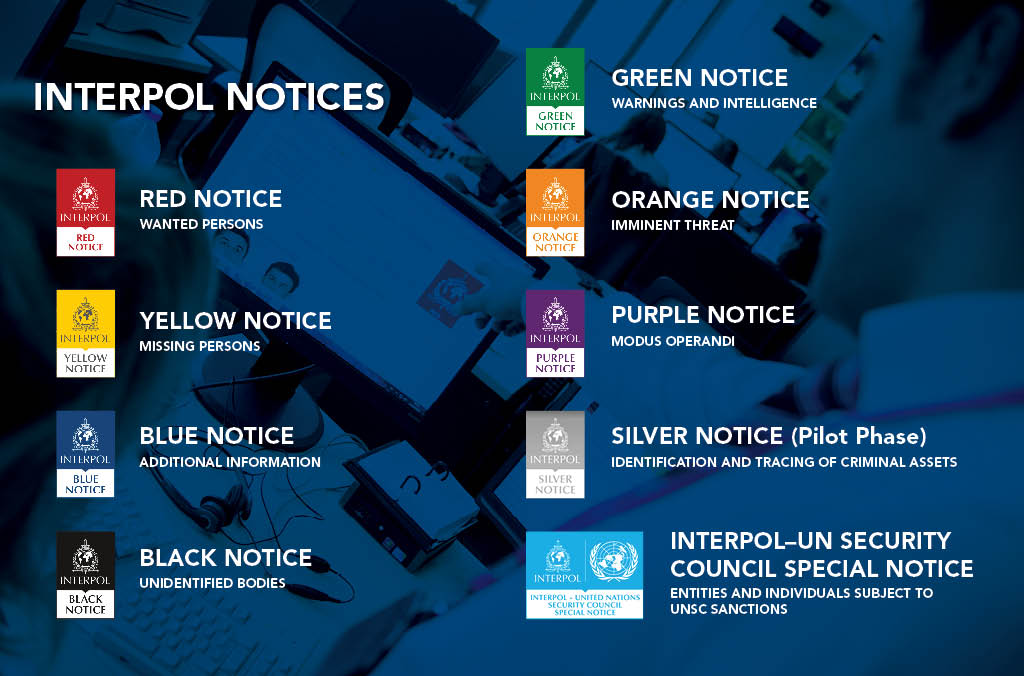
Carla Delle Donne: INTERPOL’s secure information systems hold large quantities of sensitive data, including the details on individuals and crimes mentioned in our colour-coded Notices and Diffusions, which currently include seven permanent ones and one pilot Notice/Diffusion, the Silver Notice.
The NDTF was created in 2016 to optimize the review of Notices and Diffusions for compliance with INTERPOL’s Constitution and internal rules and to ensure our Notices and Diffusions are not misused by member countries. Our main focus is our Notices and Diffusions*, but we also review for compliance data recorded in other tools, such as our Stolen and Lost Travel Documents database. After initial compliance checks by the INTERPOL National Central Bureau in the member country making the request, we verify that the data contained in all Notice and Diffusion requests received respect our Rules on the Processing of Data, with a particular focus on accuracy and the inclusion of necessary data. There are also specific additional requirements for Red Notices and Diffusions. We also review for compliance with Articles 2 and 3 of INTERPOL’s Constitution, which direct the Organization to respect the Universal Declaration of Human Rights and prohibit it from engaging in any political, military, religious or racial activities. As well as reviewing the requests we receive from member countries before publication, we have also retroactively reviewed the Notices issued before the creation of the NDTF and we continue to monitor Red Notices after publication.
INTERPOL Spotlight: What are the core skills and backgrounds of NDTF team members?
Carla Delle Donne: Our team is made up of police officers seconded by member countries, operations specialists, analysts and lawyers. As well as encompassing a wide variety of skills, team-members come from many different geographical regions and speak a total of around forty languages, with many colleagues speaking three languages fluently and some four or more. This diversity makes our analysis better-informed and gives it a sharper focus. Our colleagues work in regional clusters and track current affairs and geopolitics in their region daily, with special attention around events such as elections or unrest. We also have two subject- specific clusters. The role of the first is to liaise with the Commission for the Control of INTERPOL’s files, the independent body responsible for ensuring that the processing of personal data by INTERPOL complies with the applicable rules. The second, the corrective measures cluster, look into possible misuse of INTERPOL’s information system, including Notices , by member countries, particularly when we see high rates or repetitive patterns of non-compliance. It also works with the Organization’s wider corrective measures team to decide if action, such as enhanced supervision of requests, should be taken. We hope to avoid this kind of situation by taking a preventative approach, organizing training for law enforcement and judicial professionals in member countries across the world, on how our tools work and how to use them compliantly.
INTERPOL Spotlight: How does the NDTF carry out its reviews?
Carla Delle Donne: The information contained in a Notice or Diffusion request is always checked against other INTERPOL databases which may already contain information on the individual concerned – a fugitive, a suspect or a missing person. We may find that they are already the subject of a previous non-compliant Red Notice request, for example. We also carry out further research to assess the political context in the country concerned and check whether the person has a specific status, such as diplomatic immunity or protection as a refugee. These checks are usually rapid, but in some cases may take time, requiring seeking additional information from the requesting country or other member countries or involving in-depth research into the background of the case, for example where the request for the Notice may aim to prevent journalists from exercising their right to freedom of speech. Our goal is to ensure every review is as thorough as possible so that non-compliant Notices and Diffusions are always rejected.
*Notices are requested by one member country and communicated simultaneously to all other member countries. Diffusions are sent from one country to one or more selected countries only.